
There are two ways to run an Etsy shop.
The first is the “Artist Method.” You design what you love. You upload it with hope in your heart. You wait for the algorithm to bless you.
This is how 85% of sellers operate. It is also why 65% of them quit within the first year. They take it personally when their art doesn’t sell. They burn out trying to guess what the market wants.
The second way is the “Analyst Method.”
You don’t guess; you test. You don’t hope; you track. You treat your shop not as a creative gallery, but as a dataset waiting to be optimized.
The way you get more sales is through a data driven Etsy Strategy.
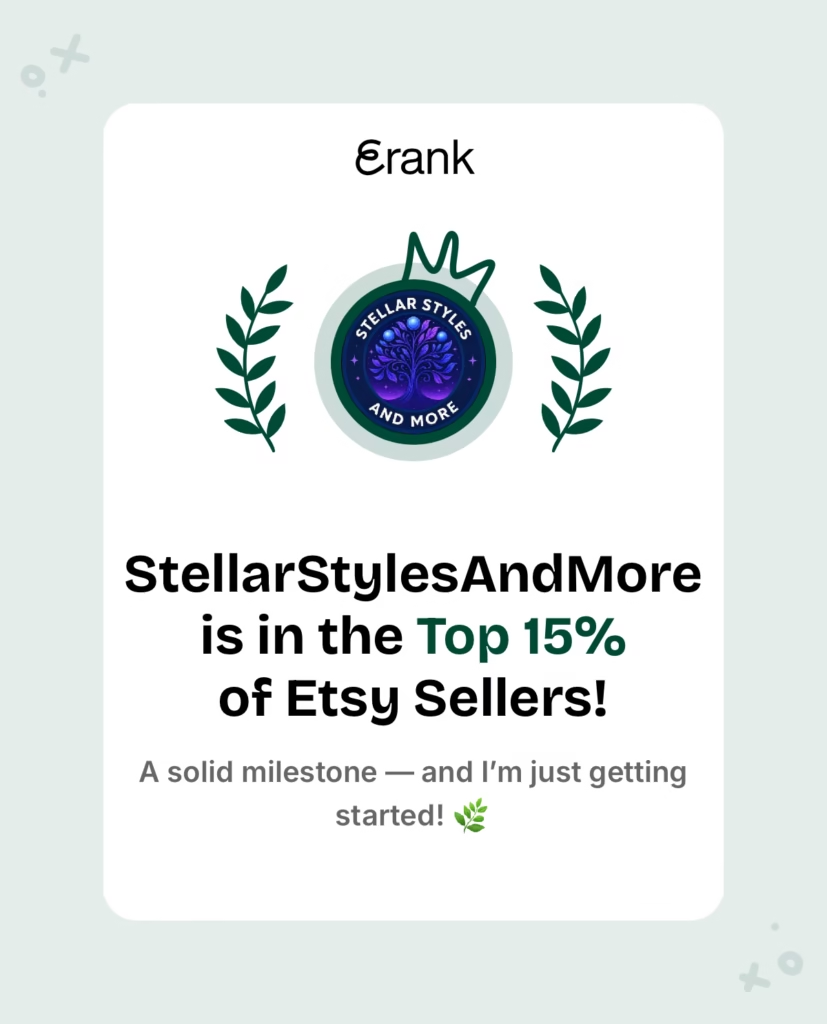
On January 6th, my shop turns two years old. I have generated over 300 sales. I officially rank in the top 15% of Etsy sellers globally.
I didn’t achieve this because I am a brilliant graphic designer. In fact, I used to be a roofer. My design skills are average at best.
If your listings are getting impressions but no clicks check this article out.
I achieved this because while other sellers are stressing over color palettes, I am looking at the numbers.
This isn’t a story about getting rich overnight. It is a blueprint on how I used data—not gut feelings—to build a sustainable, automated income stream that actually survives.
Here is the exact tech stack and daily data routine I use to outsell the artists.
The “Artist” Trap vs. The “Analyst” Edge
We need to talk about why “follow your passion” is terrible business advice.
When you start an Etsy shop based on passion, you are essentially gambling. You are betting that your personal taste aligns perfectly with the current demand of millions of shoppers. Sometimes you get lucky. Usually, you don’t.
The “Artist Trap” is the belief that if you build it, they will come.
I fell into this trap when I started. I made designs I thought were cool. I spent hours tweaking fonts and colors. I uploaded them and refreshed my stats page every ten minutes.
Nothing happened.
I was operating on feelings. The market operates on data.
Why “Follow Your Passion” fails
The market does not care about your passion. It cares about its own problems and desires.
If 10,000 people are searching for “minimalist wedding planners” and zero people are searching for “psychedelic frog coasters,” it doesn’t matter how beautiful your frog coasters are. They will not sell.
The “Analyst Edge” is the ability to detach your ego from your inventory.
When I shifted my mindset, everything changed. I stopped asking, “Do I like this design?” I started asking, “Does the data say people are buying this?”
The Top 15% badge on my Erank dashboard isn’t a participation trophy. It is proof that objective consistency beats subjective creativity every single time.
If you want to check out my article that’s teaches how to sell products on Gumroad the articles right here.
The Hidden Metrics Most Sellers Ignore
Most sellers obsess over “Views” and “Visits.”
These are vanity metrics. They make you feel good, but they don’t pay the bills. You can have 1,000 views and zero sales. That doesn’t mean you’re successful; it means you have a conversion problem.
I track two metrics that actually matter:
1. Conversion Rate: The percentage of visitors who actually buy.
2. Favorites-to-Sales Ratio: How many “likes” it takes to generate one purchase.
If I see a listing with high views but a low conversion rate, I know my SEO is working (people are finding it), but my product offer is weak (maybe the price is too high, or the photos aren’t convincing).
If I see high favorites but low sales, I know the design is desirable, but something is stopping the purchase. Usually, it’s shipping costs or lack of reviews.
Data gives you a diagnosis. Intuition just gives you anxiety.
My Morning “Stand-up”: The Daily Data Loop
You do not need to spend hours staring at spreadsheets. You just need a routine.
I treat my Etsy shop like a job. In the corporate world, teams have a “daily stand-up” meeting to review progress. I have a daily stand-up with my data.
It takes exactly 15 minutes. Here is what I do.
Step 1: The Morning Scan (Identifying the Signal)
Every morning, before I open a single design tool or answer a single email, I log into my dashboard.
I look at yesterday’s traffic sources. I want to know how people found me.
Did they come from Etsy search? Did they come from a specific keyword?
If I see a spike in traffic for a specific term—say, “sacred geometry hoodie”—that is a signal. The market is telling me something. It is telling me that demand for this specific item is heating up right now.
Most sellers ignore this. They stick to their content calendar. They say, “Well, today I planned to design flower mugs, so I’m going to design flower mugs.”
I don’t do that. I follow the signal.
If the data shows traction on hoodies, I drop everything and make more hoodies. I ride the wave while it exists.
Step 2: The Iteration (Doing “More of That”)
This is where the magic happens.
If a design works, do not celebrate. Replicate.
I see so many sellers land a bestseller and then immediately try to find the “next big thing.” They try to reinvent the wheel.
If I sell a “Psychedelic Mushroom Shirt” in black, my immediate next move is to make that exact same design available on a hoodie. Then a mug. Then a tote bag.
Then, I take the same concept and try it in a different style.
I leverage the data point. I know the concept sells. So I squeeze every ounce of value out of that concept before I move on.
This is how I got to 303 sales. I didn’t find 303 different winning niches. I found about 5 winning niches and hit them hard from every angle.
The Tech Stack That Replaces Gut Feelings
You cannot do this analysis with your brain alone. You need tools.
I use a specific “Market Intelligence Stack” to tell me what to make. These tools are my employees. They do the research so I don’t have to guess.
Erank: The Heavy Lifter
Most people use it just to check their rank. That is a waste of money. I use it for the Keyword Explorer.
Here is my workflow:
Erank is the backbone of my operation. It is arguably the most powerful SEO tool for Etsy sellers.
1. I type a broad idea into the explorer (e.g., “spiritual shirt”).
2. I look at the “Competition” vs. “Search Volume” metrics.
3. I am looking for the “Golden Ratio”: High searches, low competition.
If I see a keyword with 5,000 monthly searches and 50,000 competitors, I ignore it. It’s too crowded.
But if I see “sacred geometry crop top” with 1,000 searches and only 200 competitors? That is a green light. That is a gap in the market.
Erank tells me exactly what words to put in my title and tags. It removes the guesswork from SEO.
Everbee: The Spyglass
While Erank helps me with SEO, Everbee helps me with revenue intelligence.
Everbee allows you to “spy” on other listings. It estimates the revenue of top-selling items. This is crucial for validation.
Before I commit to a new niche, I check it in Everbee.
I want to see proof of money. I want to see that other sellers are actually making sales in this niche recently.
If I find a niche where the top sellers are making $5,000 a month, I know there is cash flow there. I know that if I can create a slightly better design or a better offer, I can capture a slice of that pie.
Everbee prevents me from entering “dead” niches where nobody is buying.
Interpreting the Signal: When to Pivot and When to Double Down
Data doesn’t just tell you what to start; it tells you what to stop.
One of the hardest parts of this business is killing your darlings. You will make designs that you love. You will think they are masterpieces.
And they will get zero views.
The “Artist” gets their feelings hurt. They blame the algorithm. They blame Etsy fees.
The “Analyst” looks at the listing audit.
If a listing has been active for 60 days and has zero views, it is dead weight. It is cluttering my shop. I deactivate it.
This keeps my conversion rate high. Etsy’s algorithm prefers shops with high sell-through rates. If you have 500 listings and only 5 of them sell, Etsy thinks your shop is low quality.
It is better to have 50 great listings than 500 mediocre ones.
The Pricing Pivot
Sometimes the data tells you the price is wrong.
I once had a design that was getting favorited 10 times a day. People loved it. But nobody was buying.
My conversion rate was 0%.
The data told me: “Desire is high. Barrier to entry is too high.”
I lowered the price by $3.00.
Sales started trickling in immediately.
I didn’t change the design. I didn’t change the SEO. I just listened to the friction point the data was revealing.
Sustainable Growth: Why Top 15% Beats “Viral”
We live in a culture that worships “going viral.”
Everyone wants the TikTok video that gets 1 million views. Everyone wants the product that sells out in an hour.
I don’t.
Viral spikes are stressful. They break your logistics. They cause customer service nightmares. And worst of all, they are temporary.
I aim for boring, sustainable growth.
My goal isn’t to have a $10,000 month followed by a $0 month. My goal is to have a steady stream of sales that grows by 5-10% every month.
That is what the Top 15% represents. It represents reliability.
The Reality Check
My current global sales rank is roughly 477,616.
I am not in the top 1%. I am not buying a Lamborghini.
But I am ahead of millions of sellers who are just guessing. I have a profitable asset that pays me while I sleep. And because I use data, I spend less time working on my shop than the people who are failing.
I have automated the decision-making process.
FAQ: Data-Driven Print on Demand
Do I need a background in data science to use these tools?
Absolutely not. If you can read a gas gauge in a car, you can read these charts. Green usually means good. Red usually means bad. The tools are designed for regular people, not mathematicians.
How much time does the daily analysis take?
15 to 20 minutes. Once you know what you are looking for, it is very fast. It saves you hours of wasted design time later.
Can this work for a brand new shop with zero sales?
Yes. In fact, it works better for new shops. You don’t have the luxury of waiting for luck. You need to target low-competition keywords immediately to get your first traction.
Start Your Data Journey
You have a choice to make today.
You can keep treating your Etsy shop like a lottery ticket. You can keep uploading random designs and hoping for a miracle.
Or, you can decide to become an analyst.
You can decide that every product you launch will be backed by research. You can decide that every price change will be based on evidence.
It starts with one step.
Go sign up for Erank or Everbee. Look at your shop from the outside. Find one keyword that is underserved. Create one listing to fill that gap.
Stop guessing. Start ranking.