

In today’s competitive online marketplace, leveraging AI can revolutionize how Etsy sellers create compelling product descriptions. From saving time to crafting engaging narratives, AI tools provide a powerful solution for optimizing product listings. This article explores in-depth strategies and techniques to effectively utilize AI in generating unique, SEO-friendly Etsy product descriptions.
Understanding AI and Its Role in E-commerce
Artificial intelligence (AI) refers to computer systems designed to perform tasks that typically require human intelligence, such as recognizing patterns, learning from examples, making predictions, and producing language. In e-commerce, AI is less about “robots” and more about software that can absorb large volumes of information and turn it into practical decisions or output. For online sellers, the most visible shift is that AI can now participate in the same work that used to demand hours of manual effort: researching customer intent, shaping messaging, and drafting persuasive copy.
At the core of modern content-focused AI are large language models (LLMs), trained on enormous datasets to understand relationships between words and concepts. They don’t “think” like a person, but they are excellent at predicting coherent, context-appropriate text when given clear inputs. This matters for Etsy because product descriptions sit at the intersection of brand voice, customer questions, and search behavior. AI tools can draft text that aligns with how shoppers browse and how they decide, as long as the seller provides the right constraints.
AI’s power comes from three capabilities that combine especially well for e-commerce content creation. First, data analysis: AI can rapidly summarize themes from reviews, competitor listings, customer messages, or your own catalog, helping you spot what shoppers consistently care about (size clarity, materials, processing time, gifting, personalization). Second, natural language processing (NLP): NLP lets AI interpret and categorize language—extracting features, benefits, sentiments, and recurring questions—so descriptions can be structured around what customers actually ask rather than what sellers assume they need. Third, text generation: once the inputs are defined (product specs, audience, tone, keywords, compliance limits), AI can produce multiple description variants, each emphasizing different angles: gifting, craftsmanship, sustainability, or problem-solving.
This changes operations as much as it changes writing. Instead of drafting from scratch, sellers can move to an iterative workflow: feed AI consistent product data, request several options, select the strongest framing, then refine for accuracy and brand fit. That means quicker launches, easier scaling across a growing catalog, and faster testing of messaging.
AI is becoming increasingly important for Etsy sellers because competition is dense and buyer expectations are high. Shoppers want instant clarity, and platforms reward listings that reduce uncertainty. Used well, AI becomes a strategic assistant: it helps translate product facts into customer-friendly language, maintain consistency across listings, and keep your shop’s voice recognizable even as you add new items.
The Importance of Effective Product Descriptions on Etsy
On Etsy, your product description isn’t just a “nice-to-have” paragraph under the photos; it’s the bridge between discovery and purchase. Search visibility, shopper confidence, and conversion rate all depend on how well you translate a handmade or curated item into clear benefits, specifics, and trust signals. Even with strong photography, customers can’t touch, try on, or inspect materials, so the description becomes the stand-in for that experience. When it’s vague, shoppers hesitate. When it’s detailed and persuasive, it removes friction and answers objections before they form.
High-quality descriptions influence Etsy SEO in two practical ways. First, they reinforce keyword relevance. Etsy’s search system uses listing text (titles, tags, categories, and descriptions) to understand what you sell and match it to shopper intent. While tags and titles carry heavy weight, a description that naturally includes buyer phrases (materials, use cases, recipient, occasion, style) helps confirm context and can support long-tail queries. Second, good descriptions reduce bounce and increase engagement—signals that, across e-commerce, correlate with stronger performance. Etsy doesn’t publish every ranking factor, but marketplace search systems generally reward listings that satisfy shoppers because they lead to completed purchases.
The persuasion element matters just as much as discoverability. Research consistently shows that better product information increases conversion. For example, Salsify’s consumer research has found that a large majority of shoppers say they’ve returned a product because it didn’t match the description, and many abandon a purchase when product information is incomplete. Baymard Institute’s large-scale UX studies repeatedly identify “insufficient product information” as a major reason for cart abandonment. Those findings translate directly to Etsy, where buyers rely on your listing to answer: What exactly is included? How big is it? What is it made of? How will it arrive? What problem does it solve or what moment does it enhance?
Effective Etsy descriptions tend to do four jobs at once:
- Clarify the item with precise specs (dimensions, materials, variations, personalization fields, care instructions).
- Differentiate by explaining what’s unique (process, sourcing, design story, limited batches, customization).
- Reassure with trust details (shipping timelines, packaging, returns, how to contact you).
- Motivate with benefits and scenarios (gift-ready, décor impact, daily use, styling ideas).
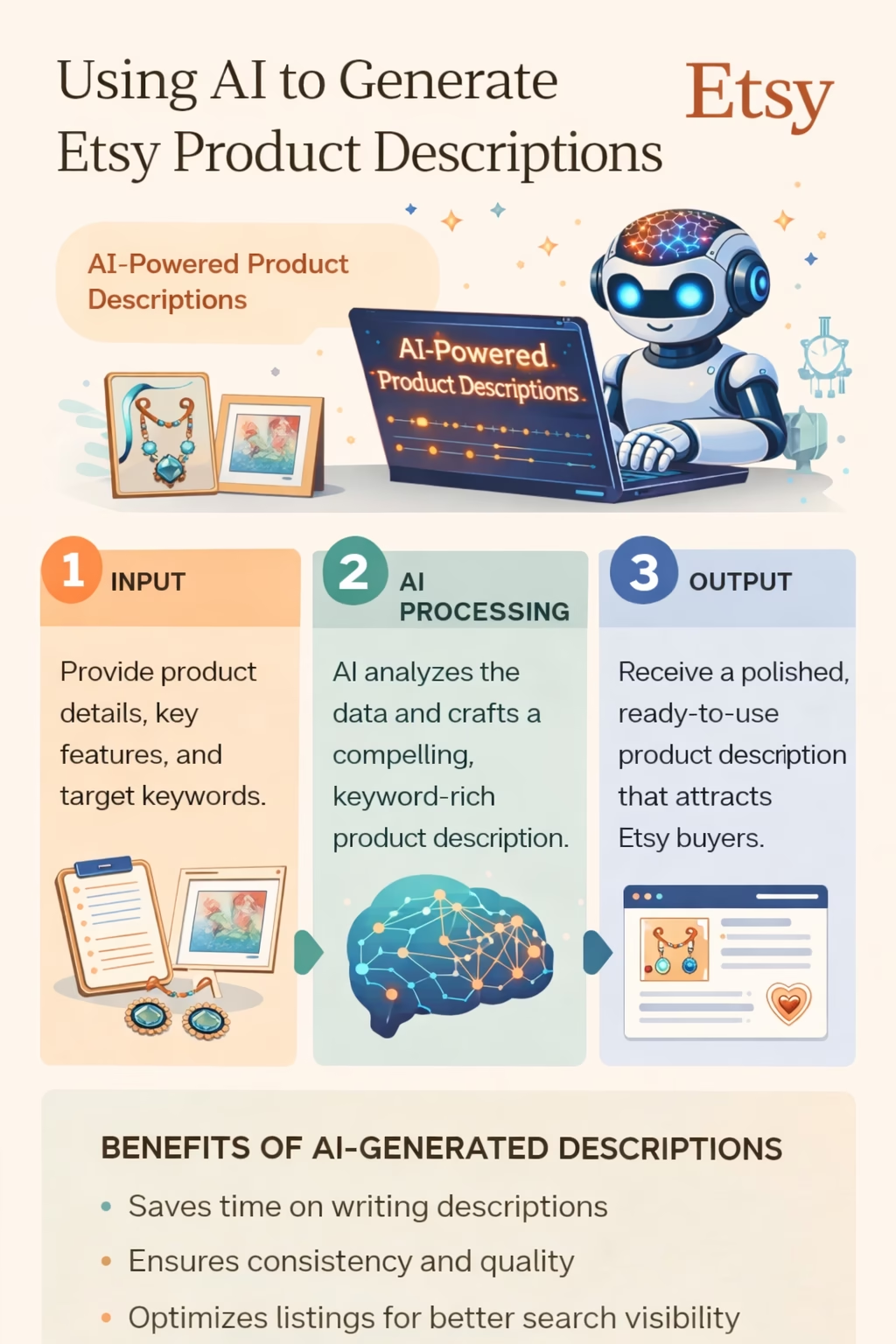
This is where AI becomes especially valuable for Etsy sellers—not by replacing your voice, but by helping you consistently cover the information buyers need, shaping it into persuasive language, and adapting it for different audiences or occasions. When you feed AI the right inputs (item specifics, target keywords, buyer persona, tone, and shop policies), it can produce structured drafts that highlight benefits, answer common questions, and reduce omissions that cost sales. That consistency becomes a competitive edge, especially when you manage multiple listings, seasonal updates, or variations that would otherwise require hours of rewriting.
Choosing the Right AI Tool for Etsy Descriptions
Choosing an AI tool for Etsy descriptions is less about “which one writes best” and more about which one fits your workflow, catalog size, and need for control. Before comparing brands, define your non-negotiables: speed vs. customization, single-shop simplicity vs. team collaboration, and whether you need SEO-friendly structure (keywords, scannable benefits, variants) or brand voice consistency across dozens of listings. Also consider how you work: if you prefer guided templates, pick a tool with strong Etsy/ecommerce frameworks; if you prefer prompting, choose one with flexible chat-style generation and reusable prompt libraries.
Key selection criteria that matter specifically to Etsy sellers:
- Template quality for product pages: Look for outputs that naturally include materials, sizing, personalization, shipping/processing notes, gifting language, and care instructions.
- Voice and tone controls: The ability to set a brand voice (warm, minimalist, playful, luxury) and keep it consistent across products is crucial when you have collections.
- Bulk generation and variation: Useful if you manage many SKUs and need multiple versions for A/B testing or for similar products with different colors or sizes.
- Editing workflow: A strong in-app editor, “rewrite/shorten/expand” tools, and the ability to highlight a sentence and regenerate it saves time.
- Cost predictability: Etsy sellers benefit from clear usage limits so description creation doesn’t become a variable monthly expense.
Among popular options, Jasper is often chosen by sellers who want tighter brand control. Its strengths are voice consistency, campaign-style organization, and robust rewriting tools. It can feel “heavier” than simpler apps, and pricing tends to be higher, but it’s well-suited if you publish frequently and want a polished, on-brand tone without constant re-prompting.
Copy.ai is typically faster for quick drafts and variations. It shines for brainstorming benefits, hooks, and alternate phrasing, and its interface is friendly for non-technical users. If you want highly structured Etsy-ready sections every time, you may need to rely more on your own prompt template (which can still be efficient once saved).
Writesonic often appeals to sellers who want a balance: ecommerce templates, decent control over output length, and pricing that can be more approachable. It’s useful for creating multiple angles (gift-focused, story-focused, minimalist) for the same product, though you’ll still want to verify specifics like dimensions and materials.
Other viable routes include ChatGPT-style tools for maximum flexibility and custom prompting, especially if you’re willing to build a repeatable prompt “recipe” for your shop. They’re excellent when your products are nuanced (handmade processes, symbolism, personalization rules) and you want the AI to follow a precise checklist. The trade-off is you must provide clearer inputs and do more manual structuring.
A practical way to decide: test the same 2–3 products in each tool, using identical inputs (materials, size, buyer intent, keywords, policies). Compare not just prose quality, but how much you had to edit to make it accurate, Etsy-appropriate, and consistent with your brand. That edit-time difference is what will matter most when you move into a repeatable, step-by-step creation process.
Step-by-step Guide to Crafting Descriptions with AI
Begin by assembling the inputs your AI needs before you open the tool. AI descriptions are only as specific as the data you feed them, so treat this like building a mini product brief. Gather: product name, category, materials, dimensions, color options, variations, personalization fields, production method (handmade, print-on-demand, vintage), care instructions, packaging, shipping/processing times, and any compliance notes (allergens, safety, age ranges). Add “buyer-proof” details too: what problem it solves, when it’s used, and what makes it different from similar listings (your design story, technique, limited edition, ethically sourced materials).
When you prompt the AI, provide context in a structured way. A simple method is to paste a short bullet list of facts first, then your request. For example: “Use only the facts below, do not invent materials or sizing. Write an Etsy description for a [type of product] with a warm, helpful tone.” Include constraints that prevent common AI mistakes: “If a detail is unknown, omit it,” and “Avoid medical claims,” or “No guaranteed delivery dates.”
Tone and style should match Etsy’s buyer personas, and you can steer that explicitly. If you sell minimalist home goods, ask for “clean, airy, design-forward language with short sentences.” If you sell quirky gifts, request “playful, punchy copy with a friendly voice.” For luxury items, specify “elevated, sensory wording, fewer exclamation points, emphasis on craftsmanship.” You can also direct the structure: “Open with a one-sentence hook, then benefits, then specs, then gift/occasion ideas, then care and shipping notes.” Ask for multiple variants to test: “Create 3 openings and 2 closing paragraphs so I can mix and match.”
Use nuance controls to keep it authentic. Tell the AI what to emphasize (e.g., “comfort and fit” for apparel; “print quality and paper weight” for art; “stone meaning” only if you can support it). If your shop has a consistent voice, paste two short samples of past descriptions and instruct the AI to mirror the cadence and vocabulary while keeping the new listing unique.
After generating the draft, refine for coherence and naturalness with a deliberate edit pass. First, fact-check every claim against your listing details. Second, remove filler phrases and overhype; Etsy buyers respond to clarity. Third, replace generic benefits (“perfect for any occasion”) with specific use cases (“bridal shower favor,” “new apartment gift,” “teacher appreciation”). Fourth, vary sentence length and swap repeated words to avoid “AI rhythm.” Finally, ask the tool to rewrite only what needs fixing: “Rewrite this paragraph to sound more human and less salesy while keeping all specs unchanged,” or “Shorten by 20% without losing key details.” This keeps the output polished and ready for SEO layering in the next step.
Incorporating SEO Best Practices
Once you can reliably prompt AI to produce clean, on-brand text, the next step is making that text discoverable. Etsy’s search is intent-driven: buyers type a need (“teacher gift”), a style (“boho wall art”), a material (“sterling silver”), an occasion (“baby shower”), a recipient, and often a size or personalization cue. SEO best practices in descriptions are about aligning with those queries while still sounding natural and persuasive.
Start with keyword research that reflects how real shoppers browse Etsy. Prioritize terms that describe what it is, who it’s for, why they’re buying, and what makes it different. Build a keyword set with three layers:
- Primary keyword phrase: the core query (e.g., “personalized leather keychain”).
- Secondary modifiers: attributes and variants (e.g., “engraved,” “minimalist,” “custom initials,” “gift for him”).
- Long-tail intent phrases: more specific, purchase-ready searches (e.g., “anniversary gift leather keychain with initials”).
AI can accelerate discovery by clustering related terms and surfacing synonyms you may miss. Feed an AI tool your product basics (materials, style, recipient, occasion, colorways, sizes, processing time, personalization options) and ask it to generate: buyer search phrases, common Etsy tag ideas, and questions shoppers ask before buying. Then cross-check the suggestions against Etsy autocomplete, competitor listings, and your own shop analytics to ensure they match actual demand rather than generic keyword stuffing.
Next, weave keywords into the description in a way that mirrors buyer intent. The first 1–2 lines should naturally include the primary phrase and the top benefit (shoppers often skim). After that, use secondary modifiers where they belong: materials in a specs area, gifting phrases in an “ideal for” line, sizing terms near dimensions, and care instructions near maintenance. Avoid repeating the same phrase mechanically; instead, rotate in close variants that keep meaning intact.
AI is particularly useful for structuring descriptions to rank and convert. Prompt it to produce a consistent layout that supports scanning:
- Opening sentence with primary keyword + outcome/occasion.
- Key features list using secondary modifiers.
- Specs (size, materials, personalization, shipping) using precise search language.
- Use cases that match intent (“gift for…” “perfect for…”).
Finally, ask AI to perform an SEO integrity check: identify missing high-intent phrases, flag awkward keyword placement, and rewrite sentences so keywords read like human language. This keeps your descriptions search-friendly now, while setting up the next step: preserving a distinctive brand voice even as you optimize.
Enhancing Creativity and Branding with AI
AI can help you produce consistent, on-brand descriptions at scale, but only if you teach it what “on brand” actually means. Start by translating your brand voice into concrete, reusable rules the model can follow. Instead of vague notes like “friendly” or “luxury,” define observable choices: sentence length, level of formality, punctuation habits, whether you use contractions, and how you speak to the buyer (second person “you,” or storytelling in first person). Then feed the AI a compact “brand voice kit” it can reference each time.
Build a brand voice kit the AI can copy
- Voice adjectives + behaviors: “Warm and witty, but never sarcastic; confident, not hypey; short sentences; one playful line max per paragraph.”
- Signature phrases and banned phrases: Add 10 phrases you love and 10 you never want (e.g., avoid “high-quality,” “perfect for,” “must-have”).
- Formatting preferences: Whether you like a quick opening hook, then benefits, then details; whether you use bullets; how you present dimensions and materials.
- Brand story micro-blurb: One or two sentences the AI can adapt (handmade process, inspiration, mission).
To preserve creative flair, give the AI ingredients, not just tasks. Provide “creative constraints” that force originality: ask for two metaphor options tied to your niche, or request sensory language anchored to the product (texture, weight, finish, sound). Creativity improves when the model has context, so include a short mood board in words: colors, aesthetic references, and the feeling you want the buyer to have when opening the package.
Strategies for prompting that keep your voice intact
- Few-shot examples: Paste one of your best-performing descriptions and tell the AI, “Match this tone and structure, but do not reuse sentences.”
- Style guardrails: Specify reading level, maximum word count, and “no clichés.” Ask for one line of brand personality, not a full comedy routine.
- Audience lens: Define who it’s for and why they care (gift-giver vs. collector vs. minimalist home decorator). This keeps the copy human and specific.
Automation should handle repetition (structure, compliance details, consistent terminology), while personalization should handle meaning. Reserve a final human pass for the parts buyers feel: your opening hook, the “why it was made,” and any nuanced guidance (gift message options, care tips, customization boundaries). Keep a “brand glossary” of preferred terms for materials, finishes, and techniques so the AI uses the same language across listings, reinforcing recognition and trust without sounding mass-produced.
Avoiding Common Pitfalls in AI Writing
AI can speed up description writing, but the fastest way to hurt sales is to treat its output as “finished.” A common pitfall is over-reliance: publishing AI text without a human check. AI often produces confident-sounding claims, vague guarantees, or feature lists that don’t match your exact item. Build a simple review workflow: verify every measurable detail (dimensions, materials, processing time, compatibility, care instructions, what’s included), and confirm the description matches the specific variant shown in photos. If you sell handmade or personalized items, double-check customization rules and ensure the text doesn’t imply impossible turnaround times.
Another frequent mistake is generic, interchangeable copy. If your prompt is broad, the model will default to safe phrases like “perfect gift,” “high quality,” and “adds a touch of elegance.” That kind of language doesn’t help Etsy’s shopper make a decision or understand why your listing is different. Force specificity by supplying the AI with a structured fact pack and asking it to use only those facts. Include: target buyer, use cases, size/fit guidance, sensory details (texture, weight, finish), and what problem it solves. Then require concrete examples: “Include two scenario-based uses and three differentiators that are unique to this product.”
Factual drift is especially risky on Etsy, where accuracy affects reviews and cases. AI may invent certifications, misstate fiber content, or claim “hypoallergenic” or “nickel-free” without evidence. Avoid regulated or absolute claims unless you can prove them. Best practice: maintain a reusable “approved claims” library (materials you actually use, test results you have, packaging you truly provide). In your prompt, explicitly ban unverified terms, and ask the model to flag any line that would require proof.
Keyword stuffing is another trap. AI can cram in awkward phrases that read robotic and may reduce trust. Instead of asking for “as many keywords as possible,” provide a short keyword list and instruct the AI to use them naturally, once each where relevant, prioritizing readability.
Finally, watch for policy and expectation mismatches: AI might imply refunds, licensing rights, or “free shipping” you don’t offer. Use a checklist before publishing:
- Accuracy: specs, inclusions, processing, personalization rules.
- Compliance: no medical/legal promises, no unlicensed IP references.
- Clarity: care instructions, digital vs physical delivery, sizing guidance.
- Trust: plain language, no exaggerated superlatives, no hidden conditions.
Treat AI as a drafting partner and your process as quality control; that sets you up to measure performance and iterate intelligently in the next stage.
Analyzing and Improving AI-generated Descriptions
Once you’ve applied human oversight and ensured accuracy, the next step is to treat your AI-generated description like a hypothesis to be tested. “Sounds good” isn’t the goal; “performs better” is. Start by defining what “effective” means for your shop, because a description can be entertaining yet fail to drive action. For most Etsy listings, effectiveness is a combination of visibility (buyers find it), engagement (buyers stay and interact), and conversion (buyers purchase or signal intent).
Use Etsy’s built-in analytics first, since it reflects real marketplace behavior. Track:
- Listing views and visits: a rise after a description update may indicate better relevance and buyer confidence (especially if traffic sources remain stable).
- Conversion rate: the clearest indicator. Monitor for at least 1–2 weeks or a minimum number of visits (your shop’s volume will dictate what’s “enough”).
- Favorites and add-to-cart: early intent signals that often change before purchases do.
To isolate the description’s impact, avoid changing photos, price, tags, or shipping profile during the test window. If you must change other elements, log them so you don’t attribute improvements to the wrong cause.
When you want faster learning, run controlled iterations. Create two description versions that differ in one meaningful dimension only (for example: opening hook focused on the recipient vs. opening hook focused on materials). Rotate changes over comparable time periods (same days of week, similar ad spend) to reduce noise. If you use Etsy Ads, keep the budget constant during the comparison to avoid artificially inflating visits.
Go beyond numbers by analyzing feedback. Mine:
- Buyer messages: questions reveal what the description failed to clarify (sizes, customization steps, turnaround time).
- Reviews: look for repeated phrases buyers use (“exactly like the photo,” “smaller than expected”). Feed that language back into the description to align expectations.
- Returns/cancellations: categorize reasons; unclear sizing and processing timelines often point to copy gaps.
AI becomes most valuable in iteration. Build a simple loop: measure → diagnose → revise → retest. Give the model your performance signal, not vague preferences: “Version B increased add-to-cart but conversion didn’t move; buyers still ask about fit. Rewrite to clarify sizing in the first 120 words and add a concise ‘How to choose your size’ list.” Over time, you’ll develop a library of proven modules—openers, benefit bullets, care instructions, customization steps—that you can recombine, letting AI generate variants while you keep the parts that consistently perform.
Conclusions
By integrating AI into your Etsy business, you can craft captivating and SEO-optimized product descriptions effortlessly. This not only saves time but also enhances engagement and sales. With tools and techniques explored here, take advantage of AI to elevate your Etsy shop, appealing to both search engines and potential buyers with your tailor-made descriptions.